Friday, 1 December 2017

Learner Profile of the month - Caring


Caring


We show empathy, compassion and respect. We have a commitment to service, and we act to make a positive difference in the lives of others and in the world around us.
IB Learner Profile


At PYP assembly, we looked at 3 pictures of students showing their caring attitude, and had a discussion. What do we see? Why do we think they are caring? What can we do if we see caring scene? Many thoughts and opinions came up. 

  • The girls in the photo are caring because they adjust the way of kicking the ball for the little girl.
  • All the students are working together and helping to pick up beads on the floor without complaining. The student who spilt the beads on the floor would be pleased. 
  • No students are excluded in the cafeteria.
  • But we need to respect the students who want to sit alone because he/she needs a quiet moment. So we ask “Would you like to join us?” nicely.
  • After you see someone caring, you can do the same to someone else. Pay it forward!

…What do YOU think?

Saturday, 7 October 2017

Great learning opportunity is not only in school


We encourage field trips a lot. Field trips are the opportunities for students to understand the concepts and connect their learnings to the world. 
In field trips, students eventually have more questions rather than in classroom at school. This is the moment when students inquire and take actions. 
Field trips can be done at home. Parents and children can discuss where they can go according to the current unit and what to look at to connect to the lines of inquiry.

Friday, 22 September 2017

Learner Profile of the month


At WISPYP, we pick up one Learner Profile every month and students discuss how they demonstrate the attribute in the class.

Open-minded


We critically appreciate our own cultures and personal histories, as well as the values and traditions of others. We seek and evaluate a range of points of view, and we are willing to grow from the experience.


What does it mean being open-minded?

We would like to ask you to discuss this question at home. How do you say “Open-minded” in your language? How do you appreciate the cultural differences? What might be happening if you open your mind to others?

Wednesday, 13 September 2017

Parent Information Evening


PYP Parent Information Evening was held. Thanks for many parents coming in.
This year our school will have more PYP parent workshops to get to know and understand more about the programme. Here is the plan for the parent workshop.

  1. Written Curriculum - 5 essential elements
  2. "Knowledge" in 5 essential elements
  3. "Concepts" in 5 essential elements
  4. "Skills" in 5 essential elements
  5. "Attitudes" in 5 essential elements
  6. "Action" in 5 essential elements
  7. Taught Curriculum - inquiry based curriculum
  8. Assessed Curriculum - PYP Exhibition
As today was the first session, I talked about 5 essential elements in PYP.


5 essential elements can't be separated and should work together always. I was thinking about a good model embodies 5 essential elements altogether...... an umbrella! 


Our school community is such a learning group. We will learn and explore the PYP more and more.

IBPYP Tweet


Tuesday, 12 September 2017

PYP Assembly


First PYP assembly was held. We will have the PYP assembly twice a month. There, students are encouraged to share their learning. We will have class presentations, group presentations, posters, play, song.... students experience many ways of showing their understandings.  

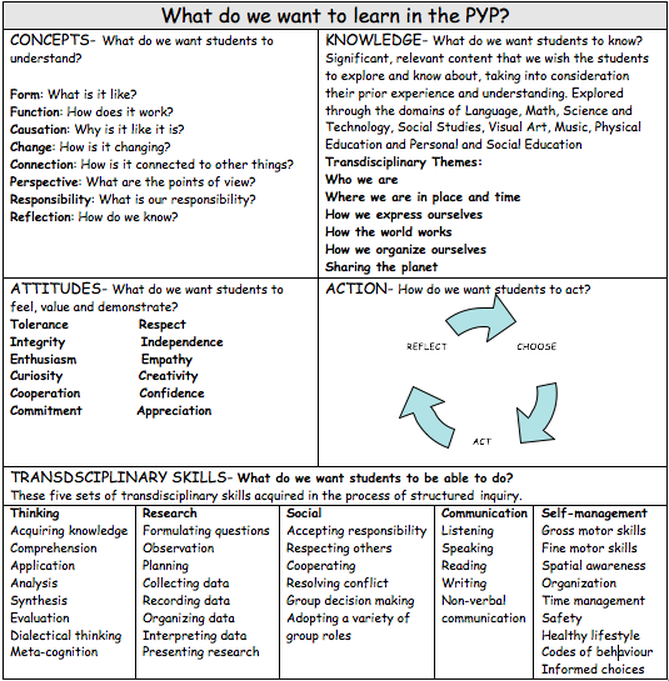
The assembly will be the one of the opportunities for student action - which is the one of the five essential elements of PYP (Knowledge, Concepts, Attitudes, Skills and Action). Moreover, the assembly is not only for the students who perform their action, but also for the students who are "the audience" to understand the concepts. This metacognitive approach to learning helps developing thinking skills. 

We look forward to seeing many students understandings at the assemblies. 

Monday, 4 September 2017

First day of school!


Welcome to the school year 2017-2018!

First day of school. Excited, happy, nervous...very emotional day indeed. Students are confident and proud of being an upper grade. Graduated PYP students are visiting us to show their MYP faces. Young PYP students (and mums also?) shed a tear but soon they get used to the new world. 
Hope everyone has a prosperous school year! 


Friday, 1 September 2017

Getting ready for the new school year!

This year, our PYP corridor will be filled with many student works, reflections, and more interactive.  
All works will be divided into 6 transdisciplinary themes - Who We Are, How We Express Ourselves, How the World Woks, Where We Are in Place and Time, Sharing The Planet, and How We Organise Ourselves. 
In the middle of the works, there is our Programme of Inquiry (PoI) which shows whole curriculum in PYP, and it will indicate which transdisciplinary theme the students are learning currently in each grade.

Tuesday, 29 August 2017

PYP staff essential agreements

In our school, each PYP classroom will write essential agreements in the first days of school. In most PYP schools, students starts the year off by creating an essential agreement instead of teachers imposing rules. This means everyone has responsibility to work collaboratively to create a better learning environment. 

Today, our teachers created the essential agreement of this school year. 

We looked at the PYP Attitudes first. Then separated into several groups, and each group chose one attitude to discuss how we dispose ourselves at work. Some groups eventually chose same attitudes and that might indicate our tendency. It was a great chance of our self-assessment. 

Tuesday, 22 August 2017

Balanced key concepts

Today we looked at the balance in key concepts in our Programme of Inquiry (PoI). 

PYP is taught through Attitude, Concepts, Skills, Knowledge, and Action. The concepts students learn are 8: change, form, function, perspective, responsibility, reflection, causation and connection. Concepts should be implemented carefully in the curriculum - for example, students need to learn through all 8 concepts in a year. Also, there should be variety of concepts in each transdischiplinary theme to encourage students to have different aspects in the same theme. 
So we looked at all key concepts in our PoI. First, we listed up and looked at grade level to see if we have all 8 concepts in each grade. Actually this activity I did 2 years ago, however I wanted to make sure again. Second, we looked at the balance in each theme (Unit of Inquiry). Then we counted all to see which concept we have more/less. 
After that activity, we found slight imbalance in some themes. We discussed what to change and edit, and finalised the whole plan of the key concept. 


This activity including discussion helped us to see and consider the balance in whole PoI, not only the grade/subject each of us teaches. 

Eventually, our activity has been caught and seen by IBPYP and they shared this on their Twitter. 😊

Monday, 21 August 2017

What is Inquiry-Based Learning?


PYP is inquiry-based. Inquiry-based learning allows children discover things, make connections and take ownership of their own leaning. Teachers become facilitators and help the children learn to think. Everyone needs to think, make good choices, find creditable information, and present findings. Learning is constructed in a way that is differentiated or that is specific to the needs of each child within the classroom.

First day of school (for teachers)

Welcome to the 2017-2018 school year!

I like the atmosphere of the first day of school for teachers.
Normally we go to school a bit earlier to say hi to colleagues. "Hey, good to see you!" "How's your summer?" - all tanned, relaxed teachers are hugging each other. New teachers are introducing themselves, smiles everywhere, and positive feelings are there. We look at the empty classrooms, and open boxes from last year and big bag from home filled with stuff. All teachers are excited and motivated for the new school year.

Today we talked about how we keep ourselves motivated to model as learners. 
Growth Mindset is the one of the keys. 
Alongside the Growth Mindset, the requirement from IB is collaboration. This is essential in teaching IB curriculum, and yet many IB schools feel it is difficult to achieve the level of requirement as collaboration needs more planning, meetings, and contributions - simply the matter of time. However, actually collaboration is not time consuming as you get familiar with doing so, and it helps your teaching a lot. Here is the link
As a community we need to collaborate more with teachers of course, but also students and parents. Also we talked about how we collaborate with educators outside of school as well as in-school. Our school has been teaching PYP for 10 years and it's high time to be mentors for schools around us. I really hope our school is going to be a hub of teacher learning. 

Wednesday, 9 August 2017

PYP Revolution?

Just finished a two-day workshop leading for 65 teachers in Japan.
The teachers were from PYP candidate schools which are local and running National Curriculum. Especially in Japan, it is quite challenging to integrate PYP with National Curriculum because of many facts - language barrier, cultural differences, and the biggest issue is the mindset of teachers and parents.

Japanese teachers are well trained and skilful in teaching. Unfortunately that's why teachers are struggling to understand the PYP, which requires inquiry-based learning. I do understand them very well as a former Japanese primary school teacher. What if the students can't inquire? What if their inquiry goes different from the plan? What if, what if....?

But they have stepped forward to explore international education to improve the quality of education in Japan. So glad to see many Japanese school teachers as well as educational leaders interested in PYP. Totally different from some years ago. International education is provoking national curriculums all over the world. 

Sunday, 2 July 2017

Growth Mindset in teachers


https://www.edutopia.org/discussion/developing-growth-mindset-teachers-and-staff

The first time I met the "Growth Mindset" was several years ago. To be very honest with you, this mindset helped me a lot.

I am Japanese. I am from the country where all students are assessed with scores, by using standard deviation and other benchmarks to see how better/worse you are compared with others. Needless to say, I did not have any of growth mindset at all.
Actually I did know that my mindset was very fixed at that time, and simply that's not so good. When EQ (or EI:Emotional Intelligence) became a hot topic - it was late 90s in Japan - I was teaching at Japanese primary school. With my colleagues I discussed a lot, especially how we use the quotient in school. We couldn't reach the conclusion. Instead, we kindly laughed at it like "Japanese will never value it". We might be right. Still.

So now I am thinking about an easy question. What if the teachers fixed mindset only? The answer is too easy to write here. But here is the next question. So what about you? How do you show your growth mindset?

Saturday, 1 July 2017

So I started

I have been teaching International Baccalaureate Primary Years Programme (IBPYP) for 10 years, and I am the PYP Coordinator as well.

Knowing many educators writing blogs, I initially hesitated to do it. First of all, I am not good at writing so much. Secondly, there was a fear of making mistakes. And finally, I had tons of excuses for not spending time for writing - yep I am always busy as you are.

Instead, I love to read educational articles. I am hunting for good ones all the time via Twitter, Facebook, etc, etc. Then I thought it would be great if I can discuss those with some people, preferably face to face. Our school has a PTA closed page on Facebook where I have been sharing those articles. But I eventually occupied the page and pushed some other info away. I felt simply bad. So, I decided to start this blog. Also, since this blog is open for public, I hope I can connect as a professional educator with other people who are interested in education. I would like to share the information/ideas/thoughts with:
- Teachers I work/worked with
- Parents of our students
- People who would like to know what's happening in international education

Voila!